
When dialect becomes dissent..
Ahmed Fouad Negm, the poet of the poor.

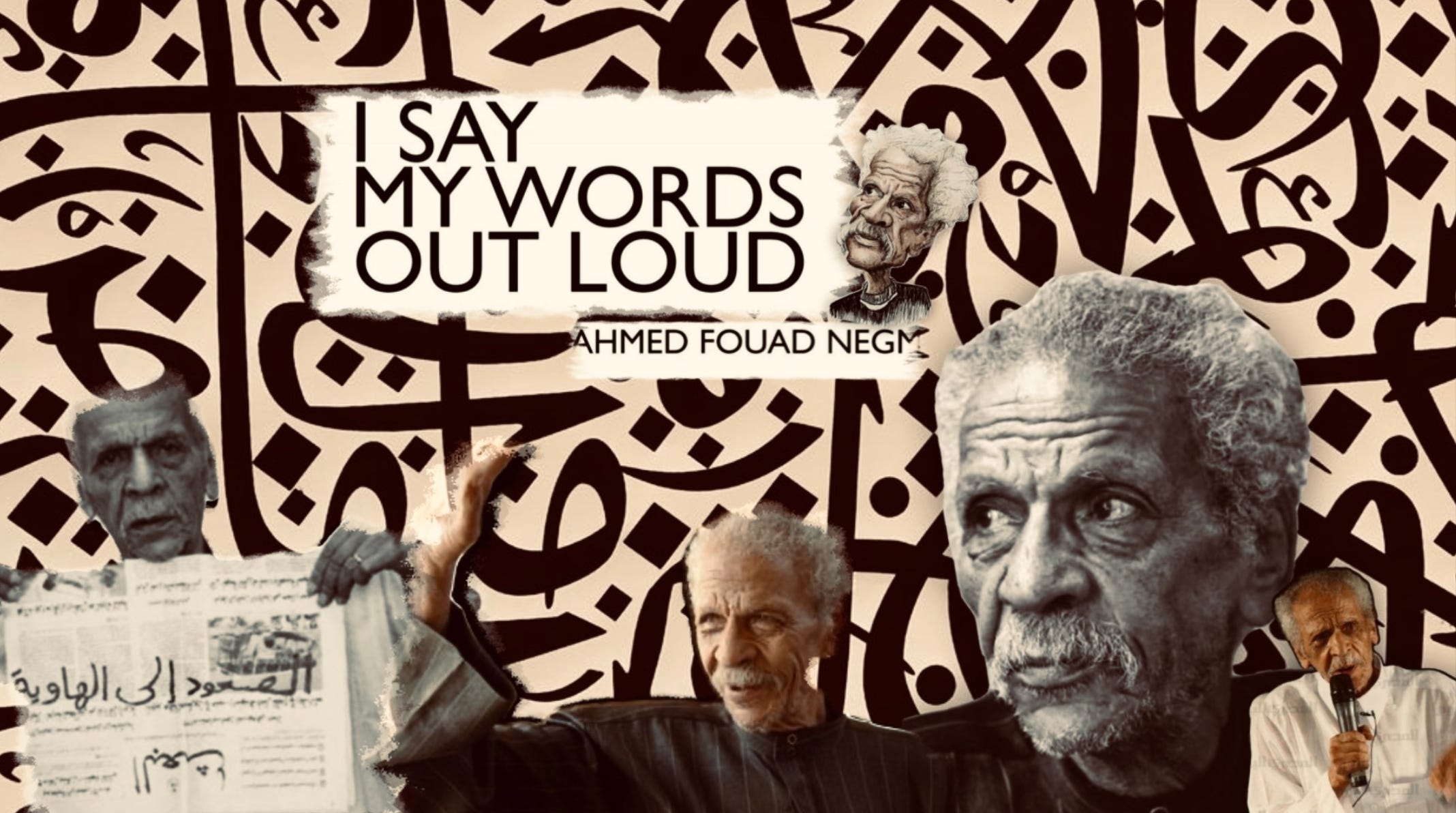
There is a kind of writing that doesn’t ask for permission, that arrives in the world without the endorsement of institutions or the blessing of those who guard the gates of legitimate speech.
Ahmed Fouad Negm wrote in ammiyya (Egyptian colloquial Arabic), the language of the street vendor and the taxi driver, the language of the mother shouting at her children in frustration. This was not the language of the academy or the state, not the language that pretends to be timeless by distancing itself from the body that speaks it. It was the language that smells of sweat and exhaust, and the particular texture of daily humiliation under power that has forgotten how to justify itself.
Classical Arabic is the language of power in Egypt, carrying the weight of religious authority, official pronouncements that echo through state media, and literature enshrined in curricula and treated as patrimony. Ammiyya is what you speak when power isn’t listening, or when you’ve decided that power needs to understand exactly what you think of it, in words it cannot ignore by claiming they lack eloquence. Negm chose the latter, and in doing so, he refused the very terms by which literature is made respectable.
Words as weapons.
Negm spent years in prison, not for organising cells or stockpiling weapons, but for writing poems. Under Nasser, under Sadat, the charge was always some variation of ‘inciting against the state,’ which was accurate. His poems did incite. They named corruption when the official story required euphemism. Mocked authority when decorum demanded deference. Memorialised the defeated and humiliated, even as the state was busy constructing narratives of dignity and resilience. They said what everyone knew, but had collectively agreed not to say. And in breaking that silence, they revealed that the silence itself was a form of collaboration with the lie.
His poems moved through Cairo as samizdat, passed from hand to hand, recited in cafes where the wrong ears might be listening. Set to music by Sheikh Imam and carried on cassette tapes that could be hidden in a jacket pocket. They were not artefacts intended for later study. They were ammunition in a war being fought in the present tense. You don’t imprison bad poets. You imprison effective ones.
The poverty that outlasts power.
Negm was born poor in 1929 and died poor in 2013. Between those years, he spent eighteen of them behind bars, imprisoned nine times across regimes. His books were banned, his voice excluded from state media, and never granted the status of “official” poet.
The United Nations named him ‘ambassador of the poor’.
International Foundations gave him awards for ‘unwavering integrity’.
Egypt gave him a cell.
When he died, thousands attended his funeral, not because of institutions that had legitimised his work, but in spite of the institutions that had spent decades trying to erase him and failed.
This reveals how counter-memory works under authoritarianism. The state controls the archive, the curriculum, the broadcast infrastructure, all the mechanisms by which culture officially reproduces itself across generations. Yet it cannot fully control oral transmission: the songs that parents teach their children, the poems that circulate in spaces beyond its reach. Negm’s poems lived because people needed them, not as historical curiosities, but as an ongoing diagnosis. Each generation found their own dictatorship described in his lines, as the structure repeats even as the names change.
Language as refusal.
To write in ammiyya is to claim that ordinary people’s speech is worthy of poetry, that the nation consists, not of its elite, but of its masses. That meaning doesn’t require the mediation of clergy or academics. Classical Arabic in Egypt carries the weight of religion, history, Pan-Arab nationalism, and all the projects that use language to claim continuity with a glorious past. It is the language of grandeur, of everything that transcends the local and particular. To write in dialect is to say that the local and the particular are enough, that Cairo’s suffering doesn’t need to be translated into universal terms to be valid.
The state prefers universals. Why? Because universals can be made vague, emptied of specificity, reduced to slogans that mean everything and nothing. Negm offered specifics instead: names, dates, prices. The lived reality of corruption, rendered in the grammar of complaint, which people use when they’ve given up on being heard by those in power and speak instead to one another.
The Revolution that remembered.
In 2011, Tahrir Square became a library of banned songs. Negm’s poems, written decades earlier, were chanted by people born after he wrote them. The words hadn’t aged because the conditions hadn’t changed. Negm himself was there, 81 years old, sick, witnessing a revolution he had written about after the last one failed.
This is the strange temporality of resistance poetry. It is always premature, written before the uprisings succeed, and with that, always usable. It doesn’t celebrate victory. It names the enemy. And as long as the enemy remains, the words remain relevant.
Negm didn’t live to see the revolution succeed, because it didn’t. The military returned, the crackdown came, and the space for dissent closed again like a fist. He died in 2013, two years after the euphoria of Tahrir, in an Egypt that was learning what many before had learned: that chanting poems is not the same as dismantling power.
But failure doesn’t ease contribution. Negm’s work achieved its objectives. It proved that the state’s narrative is not the only one. Declaring that ordinary language can carry extraordinary refusal. That poetry is not decoration, yet a form of memory that survives censorship by living bodies, which the state cannot fully monitor. Yes, the state can arrest the poet. However, it cannot arrest the poem once entered circulation.
What endures.
If Sheikh Imam gave Negm’s words a melody that allowed them to travel beyond the page. Negm gave Egyptian resistance a vocabulary. Not the vocabulary of ideology with its abstractions, but the vocabulary of lived experience. His poems are what people say when they trust each other to stop lying. When the performance of normalcy becomes too exhausting to maintain. They are the inside voice made public. The private cynicism about power made communal, transformable into something greater than individual bitterness.
Power fears this more than a gun. A gun can be wrenched from hands, buried in unmarked graves alongside those who dared to carry it. But disbelief, once it learns to speak in chorus, becomes culture. Culture is how memory survives when the archive is controlled by those you seek to resist, where official history is written by those whose legitimacy requires erasure.
Words don’t overthrow regimes. But outlast them.